Herbert
Brindilles.
M Weil + Mme X→Dilla Weil (née en 1872, à Rust, en Prusse, résidant en Sarre (Sarrebruck) depuis le 1-04-1896) & Fritz Weil (qui s’installera à Strasbourg comme représentant de commerce. Son fils Jules, longtemps employé par son père, reprendra son activité)
Dilla Cahn (née Weil) + M. Cahn (aurait été fourreur à Saarebrück, et franc-maçon)→→Fanny Cahn et Leo Cahn
Fanny Wachsberger (née Cahn) + Oskar Wachsberger →Herbert
Leo (qui avait la réputation de n’avoir jamais rien fait de ses dix doigts et d’avoir vécu aux crochets de sa mère Dilla, vivait avec elle dans la propriété qu’elle avait achetée à Bry-sur-Marne, y élevait des abeilles et y vivait en concubinage avec Edith X, elle aux crochets de la mère et du fils, sans enfants.
Dilla arrêtée et Leo disparu (arrêté vraisemblablement), Edith recevra dans la propriété qu’elle continuait d’habiter, nombres d’officiers allemands, qui y menaient grand train, dira-t-on après guerre. Je ne sache pas qu’elle ait été jamais été inquiétée Peut-être que la propriété avait été réquisitionnée ? Ce qu’on n’a, à ma connaissance, jamais dit. Ce serait du temps de la présence de ces officiers que Leo aurait disparu. Après la guerre, Edith essayera, en vain. Jules Weil étant devenu tuteur, d’obtenir elle aussi une responsabilité dans mon éducation et la gestion des biens qui restaient. Elle obtiendra que la propriété de Bry soit vendue, réclamant une part qu’elle avait obtenue. Sur quels arguments légaux ?
Fritz Weil + Mme X→Fanny & Anne & Jules.
Fanny (née Weil) + M. Franck
Anne (née Weil)+
Jules Weil + Suzanne Chassagne, dite Suzon (fille d’un Juge au Tribunal de Commerce de Bergerac et d’une charmante et très attentionnée bourgeoise, « Mme Chassagne », que j’ai connue (« on ne dit pas, un espèce de ..mais une espèce de… », ai-je appris d’elle). Ils possédaient une superbe maison (15 rue du 14 juillet, à Bergerac, que leur fille Michele s’est résolue à vendre il y a moins de dix ans). Suzon avait un frère, Robert, je crois, devenu garagiste, que ses parents considéraient sinon comme un propre à rien du moins comme un cossard. Suzon, selon mon souvenir, qui avait commencé peut-être des études de médecine, mais d’infirmière certainement, connut un amour très malheureux (un médecin ? Je me demande même s’il n’y a pas eu un avortement) et au sortir de cette douloureuse mésaventure se laissa courtiser par Jules Weil, réfugié dans le Périgord (zone libre, mais elle ne l’est pas restée) avec son représentant de père (je ne l’ai pas connu), et le reste de la famille (Fanny et Anne, belles et impertinentes jeunes femmes, dont les vies sentimentales auraient été un temps passablement agitées), mais pas sa mère (décédée ?),
Jules et Suzon se marièrent →Michèle (devenue Schmitt) & Francine (devenue)
Lili Hahnova (divorcée, si j’ai bien lu le passeport rédigé en tchèque) est arrivée en France en 1937 (a franchi les Ponts du Rhin, à Strasbourg, le 8 mars de la même année) sous le nom de Lili Wachsberger-ova
Nee le 4 août 1904 à Ostrava en Moravie, sous le nom de Wachsberger, fille de Jakob Wachsberger qui avait épousé l’un des treize enfants de son frère Hermann (sans les décédés en bas âge, il y en aurait eu dix-sept), en l’occurrence une fille, Netty, qui était donc sa nièce, et dont il aura 5 enfants (deux paires de jumeaux + un).
Lilly, l’une des cinq, était la jumelle de Frieda, mère de Vera, que vous connaissez. Elle n’a pas eu d’enfants. Absente du domicile (tout comme moi) lors de la rafle du 16 juillet 1942, elle y fut cueillie quelques jours plus tard, dix minutes après qu’elle y soit revenue. La police française, prévenue de son retour par une personne attentionnée (le concierge, M. Deliot, est cette personne à laquelle je pense), n’a pas craint les heures supplémentaires vers l’heure du déjeuner pour parfaire son travail.
Fred
My mother (Heidi) told me afterwards that my father wanted to adopt Herbert but he did not want to live in England, but now many years later I cannot really imagine what it would be like to lose ones parents in the way that they were rounded up, deported and then exterminated. In the 1950s my parents, and others, simply did not dicuss the circumstances of nazi Germany – it was too awful and there must have been the inevitable feelings of « survivors guilt » when they learned that their relatives had perished while they were ok and living in safety.
Most interesting about Samuel – he was known as Max Wachsberger, and Muckie by my family. I remember his wife Paula (and her sister Lisa Bendel) who had been living the Belgium before being reunited. For a while Muckie lived in Newcastle and worked with my father, but that did not work well, and Muckie and his family went to live in Leeds with daughter Susan. She changed her surname from Wachsberger to Walton, and then she married someone called Turp, but had no children and both died many years ago.
I shall send you a comprehensive list of what I know. Julius died when I was 18 and most information came via my mother after ge had died. My parents, and their German-speaking friends in Newcastle did not speak about what (they knew) was happening, or had happened, in Germany. It was too awful, and I would assume, they suffered from survivors’ guilt. They were living safely in a new country whilst their relatives had been taken away and exterminated …..
Obviously we all now know what did happen in Germany and Poland but only in general, with numbers in their millions. I personally was totally moved when I came across these « Stolpersteine » (stumble stones set into the roadsurface) in Regensburg, Bavaria Germany in 2019 A glimpse of history outside a house where several people lived in their apartments.
LIFE IN BERLIN
Julius had a manufacturing and wholesale business, JUWA in Magazinstrasse, Berlin.
He met Adelheid Louise Kluge (Heidi) who was a model for Modehaus Hammer, Berlin
Heidi was born in 1905 as a Lutheran Protestant and confirmed in the Kaiser Wilhelm Memorial Church in central Berlin. Julius was 10 years older than Heidi and being of Jewish faith was discouraged from a relationship with a non-Jew but they were certainly in love. Heidi went to Jewish faith conversion with a Rabbi and eventually they got married at a time when being Jewish in Berlin, in the 1930s was not what you really wanted to be.
HEIDI KLUGE
She had 2 brothers, Erich elder and Karl younger than herself.
Karl married Else, lived in Berlin and had two daughters, Ingrid and Margitta. I believe that Ingrid went to Australia, while Margitta married Detlef Schubel and lived in Berlin. During the liberation of Berlin, Else was raped by Russian soldiers which destroyed their marriage. She eventually committed suicide while Karl took to alcohol and died.
Towards the end of WW2, Erich, who had been working at the Carl Zeiss factory in Saalfeld, was taken by the Russians with his wife to Moscow where he was made to work for them (then USSR) doing secret optical work which he never discussed afterwards. They had two children, Ernst and Heidi – Heidi in turn had Ingrid who now lives in Dingolfing in southern Germany.
BERLIN TO ENGLAND
Julius and Heidi made the decision to flee to England, and Julius drove 350km to Prague in Czechoslovakia to get Czech passports in the name of Wachsbergerova (a typical Czech ending to a surname there), and they used these passports to travel from Berlin to Copenhagen in Denmark. From there to Esbjerg on the west coast, sailing from there by boat to Harwich, (Parkeston Quay) in England, and onwards by train from there to London and hopeful safe asylum.
SETTING UP IN ENGLAND
Julius and Heidi were told that they couldn’t stay in the London area but if they wanted to set up a business and employ people, they would have to go to one of the areas of high unemployment, which must be in a “depressed area” – (NE England, NW England, and South Wales)
He was met by a Mr HJ Whitehouse of NE Trading Estates (later English Estates, now UK Land) There would be grants and subsidised rents available.
They set up a limited company, Belts & Trimmings Ltd, on the Team Valley Trading Estate in Gateshead, which was the first advance industrial estate set up in England in 1938 following on from the depression years. Other immigrant families also set up here in a variety of different businesses.
They rented part of a house in Gateshead until WW2 broke out.
DURHAM
When war was declared, they were officially described as “aliens” and had to move out of the Tyneside area which was industrial with heavy engineering, shipbuilding and munitions providing much employment but also a target for German bombers. So they moved some 25km south to Durham, rented part of a house in The Avenue where Fred was born in 1941. Julius would commute each morning by train to Low Fell station serving the Team Valley.
Apart from making uniform cap peaks, chinstraps and other leather items as he had in Berlin, he was now making cases for gas masks! Ironically, together with some of the other factory owners, he took his turn sleeping in the factory doing fire-watch night shifts in case of German bombing hits.
The alien restrictions were lifted and Julius and Heidi were able to move back into the Newcastle area again, and managed to buy their first house in Gosforth, as well as a pre-war Triumph Gloria saloon car.
Newcastle had comparatively little bomb damage as it was very heavily fortified due to Vickers Armstrongs’ armaments factory in Newcastle and the shipyards along the River Tyne building warships.
AFTER WW2
In 1947 Julius, Heidi and Fred travelled by car from Harwich to Esbjerg, across Denmark and on to Copenhagen. Then by ferry to Sweden and across to Stockholm. It was only many years later that I realised that this would be a recreation, in reverse, of their journey from Germany to England via Denmark. In Copenhagen we met up with a Mr and Mrs Mortensen. Were they perhaps involved in my parents’ journey? In Stockholm we met a Mr Ragnar Fernqvist who acted as Julius’ sales agent selling uniform cap peaks and chinstraps to hat factories in Sweden. This would continue for many years. We returned to the UK from Gothenburg to Tilbury.
LIFE IN NEWCASTLE
It was obvious that business and life was good for Julius, Heidi and Fred. We moved to a bigger house in Gosforth, changed cars regularly, and enjoyed holidays in the UK and abroad. Julius and Heidi also went to the USA in 1949 and met up with brothers Leo (and wife Erna and daughter Susan) in New York and Alfred (and wife Adele) in Sacramento California. Alfred and Adele would come to the UK in 1951 and we toured around extensively together including visiting the Festival of Britain in London.
Fred could also be sent to private school in Newcastle and then to a boarding school in Edinburgh, and back to Newcastle College of Commerce to get business education, although he had expressed clearly that he did not want to go into the family business.
Julius was not religiously observant but always walked to the synagogue for the New Year holidays. Heidi did not go. But here it should be clarified that in Newcastle and across the river Tyne in Gateshead there were really 3 Jewish communities.
Orthodox – mainly in Gateshead where there was, and still is, a religious training college
Hypocrites – the main business community who were happy to drive on Saturdays but would park around the back of the synagogue so as not to offend anyone
and Reform who are believers but interpret things on a modern way. The Wachsbergers were in the hypocrite section. Heidi was deemed to be not properly converted to Judaism. Fred could not have his Bar Mitzvah in Newcastle (had to go to London …) Both Julius and Heidi smoked, as did most people, and Julius latterly suffered from angina but he still insisted on walking, about 2km, to the synagogue, refusing a lift from Heidi.
In 1959 we downsized to a bungalow near to Newcastle Airport, where 6 weeks later, Julius suffered a coronary and died aged 64. At 3.00pm the same afternoon he was buried. Yet another insult from the Hypocrite Rabbi who had him buried away from the main section of graves, near to the cemetery wall. My Jewish friends did apologise to me in the years for this but that is why I turned my back on the faith. Eventually the cemetery plots filled up and my father once again became part of the community.
On the day after Julius’ death, Heidi and Fred took over the running of the business.
In 1974 Fred married Mary (Cook) and had 2 children, Heidi and Andrew. Sadly, Mary died in 1984. Heidi married Roger Crosby and have 3 children, Daniel, James and Harriett. Andrew married Heidi Wood, and they have 3 children, Felix, Leo and Mary.
In 2009 Fred married Ruth Mitchell.orem ipsum dolor sit amet, consectetur adipiscing elit. Ut elit tellus, luctus nec ullamcorper mattis, pulvinar dapibus leo.
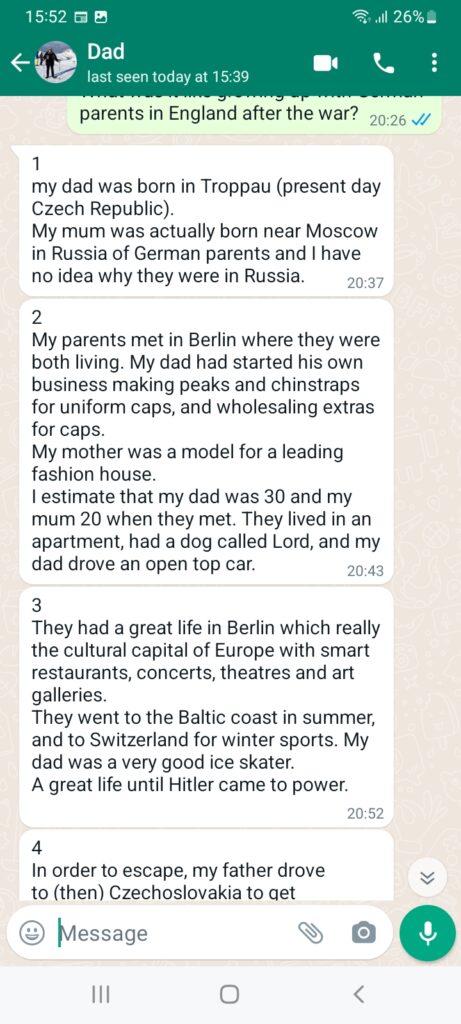
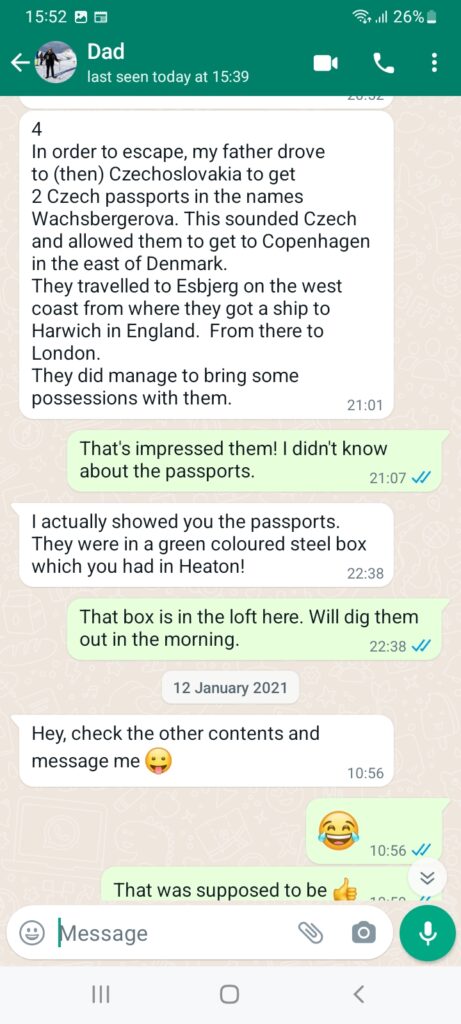
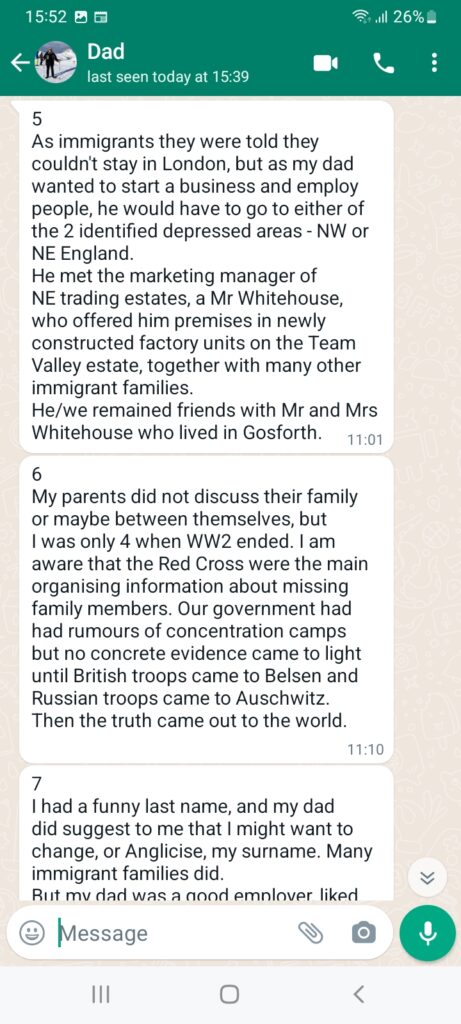
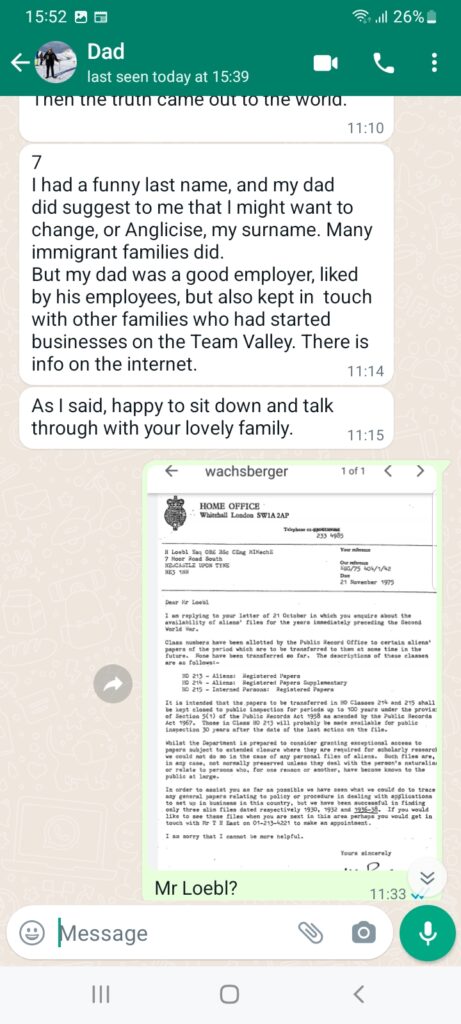
Echanges What’sApp entre Andew et Fred, mai 2023